Hetum I (1215 – October 28, 1270) was the King of Cilician Armenia from 1226 to 1269 and a prominent diplomat. He was the founder of the Hetumid royal dynasty.
Hetum I was born in 1215. He ascended the throne of Cilician Armenia in 1226, establishing the Hetumid dynasty. The preceding Rubenid dynasty, which had founded a principality and later a kingdom in Cilician Armenia, ended with the death of King Levon III. Lacking a male heir, Leo II designated his young daughter Isabella (Zabel) from his second marriage as heir to the Armenian throne, appointing Constable Constantine of the Hetumid noble family as her guardian. After Levon’s III death, succession issues caused significant complications. To resolve disputes over the throne, the Cilician nobility arranged in 1221 for Zabel to marry Philip, heir of the Principality of Antioch. Philip, pursuing a pro-Latin policy, was deposed by the Armenian lords in 1223 and imprisoned. With the throne vacant once more, the regency was assumed again by the constable, who this time became guardian not only of Queen Zabel but of the entire kingdom.
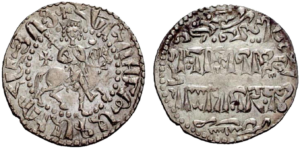
King Hetum I Tram (dram)
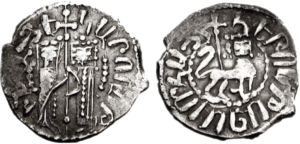
King Hetum I (1226-1270). Half tram (Half dram)
After three years of governance, in 1226, with the approval of the Armenian princely council, he married his thirteen-year-old son Hetum to Zabel, the sole heir of Leo II, and declared him King of Cilician Armenia, thereby founding the Hetumid royal dynasty.
The union of the Rubenid and Hetumid families produced nine children. Hetum I and Queen Zabel had five daughters—Fimi, Maria, Sybil, Rita, and Isabella—and four sons—Leo (January 24, 1236 – January 6, 1289), Thoros (1237 – August 24, 1266), Ruben, and Vasak. According to historical records, Vasak died in childhood at the age of four. In 1266, near the Black Mountains at a place called Mari, Prince Thoros was killed in battle against Egyptian forces, while Leo was captured. In 1268, peace was restored, and Prince Leo returned to the royal court. Thoros’s son Melchun, at his grandfather’s urging, left the court with his retinue and settled in his grandfather’s lands in Artsakh.
“Saint Nerses Shnorhali’s reliquary and other relics were entrusted by Melchun to Archbishop Michael of Khulē Monastery in Kharberd, who in turn buried them at the Monastery of Saint George” — discovered in 1839 during restoration of the monastery.
Hetum I ruled from 1226 to 1269, a challenging period for the Cilician Armenian Kingdom. In the West, the Crusades established European principalities and duchies in the Near East, often in conflict with each other. At the same time, the kingdom faced threats from surrounding Muslim states, and from the East, Mongol invasions further endangered both the Near East and Europe. In this context, King Hetum I played a decisive role.
During his reign, royal authority became more centralized, internal disputes were resolved, and by strengthening military forces and fortifying borders, Hetum pursued a policy of peaceful diplomacy that allowed economic and cultural life to flourish. To prevent the threat of Tatar-Mongol invasions, Hetum signed a treaty of peace and mutual assistance in 1243 with Mongol general Bachi Noy, and in 1254 personally concluded a new treaty with Möngke Khan in the Mongol capital of Karakorum. Between 1256–1259, with Mongol assistance, Hetum countered the aggression of the Ayyubid emirs of Aleppo, the sultanates of Iconium, and Egypt, liberating the cities of Heraclea, Marash, and Antioch with their surrounding territories, annexing southern Cappadocia and temporarily much of northern Assyria centered on Aleppo, thereby strengthening the kingdom’s international prestige.
In 1266, a strengthened Mamluk Egypt, taking advantage of the decline and fragmentation of Mongol power, invaded Cilicia with an army of 30,000, devastating numerous settlements. In July 1268, Hetum reached a peace agreement with the Sultanate of Egypt, ceding several frontier fortresses, securing the release of his son Leo from captivity, and in 1269 he abdicated in favor of Leo, retiring to a monastery in Akner village, where he later died. Hetum the Chronicler writes:
“…and having renounced the splendours of life, he entered the monastic order, taking the name Makarios, and after a short time passed away peacefully in 1270.”
Coins bearing Hetum I’s name and image were minted in gold, silver, and copper.
Hetum I’s Foreign Policy
Hetum I’s reign saw three notable achievements in Cilician Armenia’s foreign policy. During his era, the Sultanate of Rum adopted a neutral stance toward Cilicia, a strategic alliance was concluded with the Mongols, and Armenian protectorate authority was established over the Principality of Antioch. Medieval chroniclers bestowed numerous honorifics upon Hetum, including “God-fearing,” “Pious,” “Great,” “Lover of Christ,” and “Christ-crowned.” While many Armenian monarchs received similar titles, “Pious” became most associated with Hetum, reflecting his sanctified reputation. Nonetheless, beyond religious virtue, he demonstrated exceptional capabilities in economic, military, and diplomatic affairs.
Hetum’s early reign coincided with the peak of the Sultanate of Iconium under Sultan Kayqubad I (1219–1236). Soon, geopolitical shifts emerged as Mongol hordes invaded Central Asia, Persia, and the Caucasus, eventually threatening Cilician Armenia. Concurrently, the Islamic world underwent upheavals: by the 1250s, the Seljuk Sultanate of Rum and the Ayyubid Sultanate of Egypt and Syria were subdued by new powers—the pagan Mongols establishing a kingdom in Persia and the Turkish Mamluks seizing power in Egypt and Syria.
Hetum I and the Mongols
Initially, the Mongol incursions did not significantly affect Anatolia or the Near East, but the situation changed. On the eve of the 1243 Battle of Köse Dağ between Mongols and the Seljuks of Iconium, Cilician Armenia faced a critical choice: support the Seljuks and risk Mongol wrath, or refuse and secure Mongol favor. Hetum chose the latter, alienating the Sultanate of Iconium and the Mamluks of Egypt, yet securing Armenian-Mongol relations. His brother Smbat was sent to Great Khan Guyuk to negotiate; returning with a promise of diplomatic support, this paved the way for a formal Armenian-Mongol alliance.
The Mongol threat was also felt in Europe. Papal and royal envoys, including those of France’s King Louis IX, failed to establish a lasting alliance. Hetum, however, undertook personally the arduous journey to Karakorum in 1254, negotiating with Möngke Khan and securing a treaty safeguarding his kingdom, Christian territories, and the liberation of Jerusalem, demonstrating political foresight and strategic vision. Möngke Khan honored all of Hetum’s preconditions, prompting a joint Armenian-Mongol campaign, known as the “Yellow Crusade.”
Through Hetum I’s diplomatic and military acumen, Cilician Armenia temporarily expanded its influence and prestige in Asia Minor and the Near East.
Mamluk Invasions
Surrounded by hostile Muslim states and unallied Christian principalities, Cilician Armenia faced repeated Mamluk invasions. In 1266, Prince Thoros was killed and Leo captured by Sultan Baybars’ forces. In retaliation and to secure his son’s release, Hetum negotiated a treaty in 1268, ceding strategic frontier towns to the Mamluks, which connected Cilicia both to Antioch and Mongol Persia.
Death
Broken by these events, Hetum abdicated in 1269 in favor of his son Leo III, entered monastic life as Makarios, and died the same year at the Drazark Monastery near Sis.
Hetum I in Historiography and Literature
Hetum’s legacy has been underappreciated. Scholars debated whether he traveled to Karakorum voluntarily or under Mongol compulsion. Modern historians sometimes misinterpret sparse chronicler reports, suggesting he was a Mongol vassal, despite evidence of negotiation on equal terms. Unlike European rulers who demanded alliances, Hetum personally engaged Möngke Khan as an equal, reflecting the Mongols’ differentiated treatment of conquered versus allied states. The Armenian historian Kirakos Gandzaketsi notes that Mongol forces never entered Cilicia, underscoring Hetum’s diplomatic success.
French Orientalist and Armenologist René Grousset praised Hetum, noting that the Great Khan required ratification from all Christian rulers, including the Latins, highlighting Hetum’s foresight. Unlike France’s Louis IX, who failed repeatedly to secure Mongol support, Hetum succeeded in establishing a vital alliance, preserving Armenian, Near Eastern, and Christian interests.
Polish novelist Jan Dobraczyński portrayed Hetum I’s political vision and diplomatic genius in his novel The Key of Wisdom (Klucz mądrości), contrasting him with contemporary European rulers who pursued narrow self-interest, leaving Armenian Armenia isolated against Muslim adversaries. The work has not yet been translated into Armenian.
Sources:


