
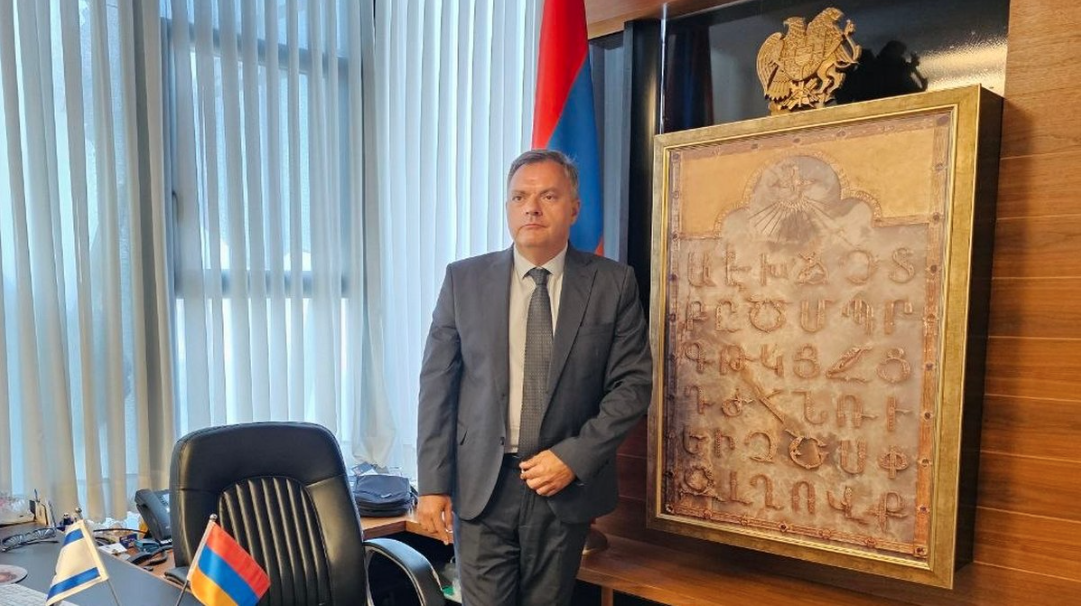
Photo by Roman Yanushevsky
A conversation about the sensitive issues and positive aspects in relations between Armenia and Israel
By Roman Yanushevsky, Editor-in-Chief of 9tv.co.il, political analyst | August 7, 2026,
Relations between Armenia and Israel are going through a difficult period. Against the backdrop of the war in the Middle East, disputes over recognition of the Armenian Genocide, and discussions about antisemitism in Armenia, new points of tension have emerged between the two countries. At the same time, behind the political statements lie deep historical ties, longstanding cultural contacts, and close personal relations between the two peoples. We spoke with Arman Akopyan, Ambassador Extraordinary and Plenipotentiary of the Republic of Armenia to the State of Israel, about how Yerevan views Israel’s decision to recognize the Armenian Genocide, why Armenia maintains relations with Iran despite its confrontation with Israel, what is happening with the Jewish community in Armenia, and why, in Yerevan’s view, Russian-language media have created a distorted picture of the situation regarding antisemitism in the country.In the interview, the ambassador explained why recognition of the Armenian Genocide is not a primary condition for bilateral relations, how he assesses Israeli society’s reaction to the decision, and why he believes that criticism of the Israeli government’s actions cannot automatically be interpreted as antisemitism. Arman Akopyan is a diplomat with many years of experience in Armenia’s foreign-policy establishment. Since 2021, he has served as Ambassador Extraordinary and Plenipotentiary of the Republic of Armenia to the State of Israel. Before his appointment to Israel, he held various diplomatic positions, including overseeing areas related to international organizations and regional policy. In his conversation with Channel 9, the ambassador also shared his personal observations about the life of the Jewish community in Armenia, spoke about the centuries-old ties between Armenians and Jews, and explained why, in his view, relations between the two peoples cannot be measured solely through the prism of current political conflicts
— Tell us about yourself. How did you enter diplomacy, and how did your career develop before you were appointed Armenia’s ambassador to Israel?
— This November will mark exactly 35 years since I began working at the Ministry of Foreign Affairs, essentially from the establishment of independent Armenia in 1991. Before that, I was involved in academic research and teaching. I graduated from Yerevan University’s Faculty of Oriental Studies, specializing in Arabic language and literature, although my main focus was Semitic studies. I have been interested in Semitic languages since I was at school.
— Why did you choose this particular field?
— I was simply interested in it. There was no particular reason. While studying at university, in 1986–1987, I spent some time in Jordan. There, because it was possible to watch Israeli television and listen to Israeli radio, my knowledge of Hebrew improved significantly. I even attended Hebrew courses, but at a certain point I realized that I could already teach the language myself.
— So when you came to Israel, you already had a certain foundation in the language?
— Yes. And not only in Hebrew, but also in Aramaic. Knowledge of Arabic is extremely helpful when learning other Semitic languages. Arabic is such a rich and complex language that after studying it, many other Semitic languages become considerably easier to learn.
— How many languages do you speak?
— Professionally, I use English, French, Portuguese, Hebrew and Arabic. I also know Aramaic, Russian and Armenian. Aramaic is more of an academic field for me, since almost nobody speaks it today. But I can read most Semitic languages.
— Israel has several small communities that speak modern Aramaic. Are you studying those contemporary dialects?
— No, I study Classical Aramaic. Neo-Aramaic languages exist among certain communities in northern Iraq, Iran and Syria, as well as in Armenia. Those are modern dialects. I am more interested in the classical language, particularly the language of the Targum Onkelos, one of the most important works of Aramaic literature. (Onkelos was a Roman who converted to Judaism and translated the Torah into Aramaic. His translation became the most widely used Torah translation throughout the Jewish diaspora of that period.)
— As I understand it, you have also written textbooks on these languages?
— Yes. In 1995, I became the first person in Armenia to teach Hebrew at the Faculty of Oriental Studies. Before that, I taught Arabic and proposed adding Hebrew as a second Semitic language. Hebrew has remained part of the curriculum since 1995. In 2001, my Hebrew textbook was published and later reissued. I also wrote a textbook on Classical Syriac. Syriac is one of the dialects of Aramaic used by Aramaic-speaking Christians. It was one of the most important languages of early Christian thought, alongside Greek and Latin.
— Did Jesus speak Aramaic?
— Yes. It is generally believed that Aramaic was the spoken language of the period, which is why many phrases associated with Jesus belong to that language. The New Testament itself was written in Greek, but it contains individual expressions in Aramaic. My Syriac textbook was later published in Moscow in Russian and in the United States in English. In 2021, another textbook was published, this one on Middle Palestinian Aramaic—the same language in which the Targum Onkelos was written. I also wrote Introduction to Aramaic Studies and Syriac Studies, which was published in Russian and English.
— Let us return to your professional career. After university, did you continue your academic work?
— After graduating from university, I entered the postgraduate program at the Institute of Oriental Studies of the Armenian Academy of Sciences. I wrote my dissertation on Israel: Nationalist and Religious Parties in Israel’s Party-Political Structure. It was the period of perestroika, when interest in Israel grew considerably and the previous restrictions no longer existed. After the collapse of the Soviet Union, that interest changed somewhat, and I focused more on philology and began teaching at the university. In 1991, I was invited to work at the Armenian Foreign Ministry. Initially, I had not planned to enter diplomacy, but I was persuaded to do so because of my knowledge of Eastern languages and the Middle East. I have worked within Armenia’s Foreign Ministry ever since.
— In which countries have you served as a diplomat?
— My first posting was in Egypt, where I worked from 1992 to 1995. I then spent three years at Armenia’s Mission to the United Nations in New York, from 1999 to 2002. That was the period of the September 11 attacks—a very difficult and important time. From 2006 to 2011, I headed the Armenian Embassy in Canada. In 2020–2021, I was ambassador to Brazil, and then I was appointed to Israel.
— After Brazil, was the move to Israel unexpected for you?
— In a sense, yes. All my previous assignments had been overseas—in New York, Canada and Brazil. I had become accustomed to long distances and long flights. Here, everything is different: it is less than a two-hour flight to Armenia. It is unusual for me to work so close to Armenia, because I had never had that experience before.
— In diplomacy, there are often countries considered more prestigious postings. For example, in many countries, an embassy in the United States is regarded as one of the most important. Is there such an unofficial hierarchy within Armenia’s Foreign Ministry?
— I don’t think it is formally established in any way. Naturally, major powers and the permanent members of the UN Security Council have particular importance. But every country is important in its own way. Each country has its own challenges and opportunities. You cannot simply make a list in which one country is more important than another.
— Is Israel an important destination for Armenia?
— Yes, absolutely. Although diplomatic relations between Armenia and Israel were established in April 1992, shortly after the collapse of the Soviet Union, I remember the process of establishing those relations very well. At the time, I worked at the Foreign Ministry and was responsible for the Israeli portfolio. When Israel’s first ambassador, Aryeh Levin, came from Moscow to establish diplomatic relations, I accompanied him and sometimes even helped with translation. The Armenian Embassy in Israel, however, opened only in 2020. For many years before that, Armenia was represented by non-resident ambassadors. Today, it is obvious that Israel is an important country both regionally and globally. For Armenia, this is particularly significant because of the historic Armenian presence here in Jerusalem.
— You mean the Armenian Quarter?
— Yes, the Armenian Quarter and the Armenian Patriarchate. The Armenian Church, together with the Orthodox and Catholic Churches, has a special status and equal rights regarding the Christian holy sites of Jerusalem. For Armenia’s ambassador, this naturally creates an additional sense of responsibility.
— You have said that working in every country has its own particular characteristics. What are the most rewarding aspects and the greatest challenges you face as Armenia’s ambassador to Israel?
— The most rewarding thing is the country itself. Israel is extremely interesting for a diplomat and personally for me as someone who spent many years studying the country academically. I enjoy simply traveling around Israel, visiting archaeological sites and reading ancient inscriptions in old synagogues. For someone interested in history and languages, it is a unique opportunity. From a professional perspective, however, it is a serious challenge. I arrived in Israel at the beginning of 2022, when the country was still dealing with the COVID-19 pandemic. The first year was essentially spent under restrictions. Then the situation gradually stabilized, but October 7 happened and a new, extremely difficult period began. We had to evacuate Armenian citizens. Some members of my own family were among them—my daughter and mother-in-law were visiting here, and I had to evacuate them together with other Armenian citizens. After that came the wars with Hamas and Iran. Living in such a reality is not easy, but for a diplomat it is an important experience. You have to be able to work calmly and professionally even under constant pressure. At the same time, for someone who has spent his entire life being regarded as a specialist on the Middle East, finding himself at the center of the region’s events is a very interesting experience.
— How large is the Armenian community in Israel? And what proportion of it consists of Armenian citizens?
— It is a mixed concept. Historically, the Armenian community in Israel has primarily consisted of Armenians living in Jerusalem’s Old City, in the Armenian Quarter. The quarter has existed for around 1,500 years, since the establishment of the Armenian Patriarchate here. Some residents of the quarter hold Israeli citizenship, while others retain Jordanian citizenship. In the early 1990s, a second wave of the Armenian community emerged, connected with immigration from the former Soviet Union. Many Armenians, including people from mixed families, came to Israel. This community is considerably larger than the old Jerusalem community. Today, we can speak of approximately 10,000 ethnic Armenians in Israel. Among them are both Armenian and Israeli citizens.
— There are several Armenian restaurants in Jerusalem. Where can one try authentic Armenian cuisine?
— There are several well-known places in Jerusalem itself. One restaurant is located right next to the Armenian Patriarchate and is called Armenian Tavern. There is also the Yerevan restaurant near the New Gate of the Old City. Another Armenian restaurant is located on the premises of the Armenian Catholic Patriarchate, not far from Damascus Gate. There are Armenian establishments in Bethlehem as well, but if we are talking specifically about Jerusalem, these are the three best-known ones.
— Which cuisine most closely resembles traditional Armenian cuisine?
— Surprisingly, Italian cuisine. Not in terms of specific dishes, but rather in terms of the approach: a large amount of fresh herbs, natural products, cheeses and tomatoes. Armenian cuisine uses few artificial seasonings. The flavor comes primarily from herbs—tarragon and various greens. Armenia has an enormous variety of greens used in cooking. There is a traditional dish that is something like a “shepherd’s sandwich”: lavash, boiled eggs, cheese and tarragon. It is simple food, but extremely popular.
— There is a certain paradox: Armenians have lived in Jerusalem for more than 1,500 years, the two peoples have many historical connections, and Christianity and Judaism share common roots. Yet diplomatic relations were established only in 1992, and Armenia’s embassy opened only in 2020. Why did relations develop so slowly?
— First of all, it was a gradual process. After gaining independence, Armenia was in a difficult situation: there was a conflict and serious economic hardship. The number of embassies grew gradually. The opening of an embassy in Israel was always discussed and the issue was repeatedly raised. But there was another side to it: Israel also did not open an embassy in Armenia. To this day, Armenia remains one of the few post-Soviet countries where Israel does not have an embassy. Such decisions are usually based on reciprocity. For a long time, the Israeli side explained this by saying that it lacked the necessary resources. But in my view, there is no longer any reason to postpone this step.
— Have you raised this issue in meetings with Israeli officials?
— Of course. I have discussed it. The answers vary. I do not want to speak on behalf of Israel’s Foreign Ministry; they have their own arguments. We can understand some of the reasons, while we are more skeptical about others. But our position is simple: today, there is nothing preventing Israel from opening an embassy in Armenia.
— Why, in your view, have relations between the two countries been more complicated than one might expect?
— I would not say that we have had any serious problems in our relations with Israel. The most difficult moment was the supply of Israeli weapons to Azerbaijan during the Second Nagorno-Karabakh War. This provoked a very negative reaction in Armenia. During the war, many countries halted arms supplies, while Israel continued supplying weapons to Azerbaijan throughout the 44 days of fighting. This left a serious mark on the way Israel was perceived in Armenian society. But we believe this is a chapter that can be turned and that we can move forward.
— Another issue causing concern in Israel is Armenia’s relationship with Iran.
— Here, one has to take the specific circumstances into account. People often forget that Iran is Armenia’s neighbor, one of the four countries with which we share a border. It would be strange not to try to maintain good-neighborly relations with it. In this regard, we can actually take Israel itself as an example. Israel has managed to establish, albeit difficult, peaceful relations with two of its challenging neighbors. Armenia is a landlocked country, so all transport and trade links are important to us. Through Iran, we have access to the Persian Gulf; through Georgia, to the Black Sea. People also often forget that Armenia is a Christian country. It is not under Iran’s ideological influence. It is not a Shiite state, and by definition the religious and political systems of the two countries are completely different. The majority of relations between the two countries concern the economy, energy, tourism and culture.
— Are there many Iranians living in Armenia?
— There are people who live and conduct business there, but most are tourists. Particularly large numbers arrive during Nowruz, the Iranian spring festival. For many members of Iran’s middle class, Armenia is an attractive destination where they can spend their free time more freely than they can at home.
— What do you know about the activities of Iranian intelligence services in Armenia?
— I personally have no information about this. I do not rule out the possibility that every country conducts a certain amount of intelligence activity, particularly neighboring states. But I am not aware of any major incidents or cases that I could speak about.
Recognition of the Armenian Genocide
— Let us turn to the issue of recognition of the Armenian Genocide. The tragedy occurred more than a century ago, yet the controversy continues. Israel has recently, in effect, recognized the Armenian Genocide: first the prime minister made a statement, and then the government unanimously approved a corresponding decision. How was this received in Armenia?
— The official position of Israel’s Foreign Ministry is that the unanimous government decision is sufficient grounds for Israel to be considered a country that has recognized the Armenian Genocide. That is what I have heard from senior Israeli officials. But there is another interesting aspect. For many years, Israel was criticized with the question: how can a country that experienced the Holocaust itself fail to recognize the Armenian Genocide? Now recognition has taken place, albeit very belatedly, but the reaction has been ambiguous.
— Instead of a “better late than never” reaction, we are seeing debate and criticism.
— If we are talking about the official position of Armenia, Prime Minister Nikol Pashinyan stated very clearly that this issue should not be used as a political weapon against any country. But there are two sides to the matter. One is the official position of states; the other is the position of civil society. And if we are talking about Israeli society, it cannot be denied that the overwhelming majority of civil society activists and public figures have long supported recognition of the Armenian Genocide. I analyze media publications and social networks and monitor comments beneath articles. Based on my observations, approximately 80% of people who express an opinion on the subject believe that Israel should have recognized the Armenian Genocide long ago. There are very few people who completely deny that the genocide took place. There are also people who acknowledge that the genocide occurred but believe that the state should not make a political recognition of it. Interestingly, support for recognition is somewhat lower in the Russian-speaking segment. According to my rough estimates, it is around 75–80%. One might think that among Russian-speaking Jews there would be greater understanding of the Armenian issue, given the historical closeness between the two peoples and the large number of mixed families.
— Could this be related to the fact that many Russian-speaking Israelis come from Azerbaijan—a country for which this is a difficult and sensitive issue?
— It may be one of the factors, but I would not want to draw such conclusions. In general, it is surprising that in a society where there is such historical closeness between Armenians and Jews, the issue is perceived so ambiguously. When I was asked about this in the past, I avoided political comments. But I did say one thing: recognition reflects a position that has long existed within Israeli society. In effect, the official position of the state has finally moved closer to public sentiment.
— Why, then, was the reaction in Armenia not equally unequivocal?
— Interestingly, similar questions were raised not only in Armenia. Immediately after the reports of recognition in Israel, a debate emerged: “Morality or geopolitics?” People asked: Is this historical justice or a political calculation? That became the central issue in subsequent discussions in the Israeli press as well: Why now? Why after so many years? It is important to understand that Armenia has never asked other countries to recognize the Armenian Genocide. For us, this is not the foundation of bilateral relations. We have excellent relations with many countries that have not recognized the genocide. Today, Israel has become the 33rd country to officially recognize the Armenian Genocide. The initiative for such recognition usually emerges from within the countries themselves rather than coming from outside. This is not the first time the issue has been raised in Israel either. The matter has been brought before the Knesset many times, with individual lawmakers and political parties supporting recognition. Several years ago, a relevant Knesset committee had already considered the issue.
— Will Israel’s recognition affect relations between the two countries?
— I do not think it will dramatically change our bilateral relations in any way. As I said, for Armenia, recognition is not the main factor in our relations with other countries. We take this development into account. Every state makes such decisions for its own reasons. Over time, people forget the political circumstances, but the fact of recognition itself remains. With Israel, perhaps the circumstances surrounding the decision will be remembered for longer, because there was much more debate and attention surrounding it.
— Could the resonance be related to the fact that there is an Armenian community in Israel?
— No, I do not think that is the only reason. The Armenian community in Israel is not large enough to generate such public resonance on its own. Moreover, the initial reaction in Israel did not come from the Armenian community. Publications and debates emerged immediately within Israeli society itself.
Antisemitism and criticism of Israel
— You mentioned publications in Russian-language media and the issue of antisemitism in Armenia. Why, in your view, has this subject received so much attention?
— I was surprised that after Israel recognized the Armenian Genocide, this issue received such extensive coverage. And it is not limited to official discussions; it also concerns publications in the Russian-language press. In recent years, this is not the first time that the issue of “antisemitism in Armenia” has appeared specifically in Russian-language media. I have a question: Why has Armenia become the focus of such attention? When you read some of these publications, you get the impression that Armenia is one of the most antisemitic countries in the world. But if you look at the broader picture, attacks on Jews, vandalism of synagogues and manifestations of antisemitism occur in many countries. The question arises: Why is the focus placed specifically on Armenia rather than on countries where much more serious incidents take place? At the same time, I am not claiming that there is no antisemitism in Armenia. As in every country in the world, there are stereotypes, prejudices and individual antisemitic statements. Armenia is not a country of angels. If someone sets out to find antisemitic statements in Armenia, they will certainly find them. But the real question is: To what extent do these incidents reflect society as a whole? There is another important point: not every criticism of Israel automatically constitutes antisemitism. Even the International Holocaust Remembrance Alliance (IHRA), which developed the working definition of antisemitism, states that criticism of the actions of the Israeli government is not in itself antisemitic when it is comparable to criticism directed at any other state. There have indeed been painful issues in Armenia related to Israel. For example, criticism of Israel’s sale of weapons to Azerbaijan during the war.But this concerned the policy of a state, not Jews as a people. In addition, Armenians closely follow the issue of Israel’s recognition of the Armenian Genocide. For many people in Armenia, the long absence of such recognition was painful, particularly given the history of the Holocaust. We must also remember that during certain periods Israel did cooperate with Turkey in opposing international recognition of the Armenian Genocide. This was also reported by Israeli media.
— You also mentioned attacks against Armenians in Jerusalem’s Old City. How much does this issue influence perceptions of Israel in Armenia?
— It is one of the factors that attracts serious attention in Armenian society. In recent years, there have been increasing incidents of hostility toward Armenians and Christians in general in Jerusalem’s Old City. It is important to emphasize that this is not only a problem for the Armenian community. More broadly, it concerns manifestations of anti-Christian hostility. But there have also been specific incidents targeting Armenians: threatening graffiti, attacks on Armenian establishments and attempts to exert pressure regarding Armenian property.When Armenian society sees such events and asks questions, that does not necessarily constitute antisemitism. Criticism of specific actions—or inaction—by authorities is a normal part of public debate. If Armenians are attacked in a particular country and the police fail to respond appropriately, people have the right to speak about it.
— Critics argue that such publications sometimes cross the line and turn into antisemitism.
— It all depends on the context. You can find individual radical statements in virtually every country. But you cannot use isolated comments to draw conclusions about an entire society. It seems to me that the problem is that some authors are trying to create the impression that Armenia is an institutionally antisemitic state. For example, the organization ASALA is often mentioned. But that organization ceased to exist in the early 1980s. It was primarily directed against Turkey and was not an antisemitic organization. If someone wants to prove that antisemitism exists in a particular country, they can collect material from marginal websites and individual extremist groups. But that does not present an accurate picture of society.
— Regarding the attacks on the synagogue in Yerevan: those incidents did happen, did they not?
— Yes, there were indeed attacks on the Mordechai Navi Synagogue. No one denies that. These are disgraceful incidents that must be investigated and condemned. But similar incidents occur in many countries around the world. If you take any major European city and examine its history over the past 20 years, you will find cases of attacks on synagogues. In one of the incidents in Yerevan, security cameras did record a person throwing a bottle containing an incendiary substance. He then immediately left the country. (Editor’s note: according to media reports, he went to Russia.) But something else raises questions. Information about the incident appeared in some foreign sources literally within minutes of the attack, before the police had even had time to begin their investigation. The question is: How was such rapid reporting possible, and why did a ready-made interpretation of the event appear immediately? Let me repeat: all manifestations of antisemitism must be condemned. Desecration of Holocaust memorials and attacks on religious sites are unacceptable. But one cannot conclude from this that a small country with a small Jewish community is some exceptional center of antisemitism.
— How many Jews live in Armenia today?
— According to the Soviet census, more than 5,000 Jews lived in Armenia. Most subsequently immigrated to Israel. For some time, around 1,000 members of the Jewish community remained in the country. But after 2022, an interesting phenomenon occurred: large numbers of new immigrants arrived in Armenia from Russia, Ukraine and Belarus, among them many Jews. In effect, Jewish life in Armenia experienced a revival. New organizations appeared, events are being held, and Shabbat gatherings take place. I have participated in some of these events myself and have seen this community firsthand. Against this background, we periodically read reports claiming that Jews in Armenia are afraid to go outside and have to leave the country. That is surprising. Why does no one ask the Jews who actually live there? When representatives of the Jewish community say that antisemitic incidents have indeed occurred, their statements are accepted. But when they say the opposite—that the situation does not correspond to the picture presented in certain publications—they are told: “You are dependent on the authorities and are forced to say that.” That is a double standard.
— But the issue is not only individual publications. Are you talking about a broader phenomenon?
— Yes. The issue is not a particular journalist or a particular article. I am talking about a phenomenon that has been repeated for several years. This is not the first time publications have appeared portraying Armenia as a country with deeply rooted antisemitism. What is striking is that I see virtually no comparable material in the Hebrew-language press. In Yerevan, for example, there is a memorial dedicated to the victims of the Holocaust. It has stood in the center of the city for many years. Yes, there have been attempts to vandalize it, but the response was swift: municipal services immediately arrived, cleaned it and restored it. Of course, such incidents happen. The question is to what extent they reflect society as a whole. Returning to the issue of criticism of Israel: Can harsh criticism of the Israeli government be considered antisemitism? No. Moreover, if we followed that logic, we would have to conclude that the strongest antisemitism exists within Israel itself, because nowhere in the world is the Israeli government criticized as harshly as it is by Israelis themselves. I observe the debates in Armenia and notice something interesting: when some Armenians criticize Israel, they most often do not speak about Israel as a country and certainly not about Jews. They speak about specific politicians. Therefore, one cannot automatically turn every political position into an accusation of antisemitism.
Armenian-Jewish Relations
— How would you describe Armenian-Jewish relations overall?
— Historically, there has always been a sense of closeness between the two peoples. During the Soviet period, Armenian-Jewish mixed marriages were very common. In terms of the number of such marriages, Armenians ranked among the highest of the peoples of the Soviet Union. Among Armenians, Jews ranked approximately third, after Russians and Ukrainians. That is why there are so many well-known people of Armenian-Jewish heritage: Sergei Dovlatov, Yevgeny Petrosyan, Garry Kasparov and many others. For Jews, Armenians were also one of the more prominent groups in terms of mixed marriages. This demonstrates that the relationship between the two peoples involved not only official relations but also genuine human closeness. Even during the Soviet period, Armenia was perceived by many Jews as a more comfortable place to live. When some Soviet Jews who were denied permission to emigrate were expelled from Moscow and Leningrad beyond the 101st kilometer, some of them ended up in Armenia. I myself attended a school where there were families like this.They came there precisely because they considered Armenia a republic where one could live peacefully and where everyday antisemitism was less prevalent. This is a very interesting subject that still requires serious academic research.
— So the current image of Armenia as an antisemitic country does not correspond to your experience?
— Of course not. That does not mean that antisemitic manifestations have never existed or do not exist in Armenia. They do, just as they do in every country in the world. But you cannot take individual incidents and use them to create an image of an entire society. It is also important to understand the distinction between antisemitism and criticism of Israeli policy.
Source:


